
Book
A Village, A Town, a Roadtrip is the first book in an intended three-book series of stories set in 1950’s Ireland.
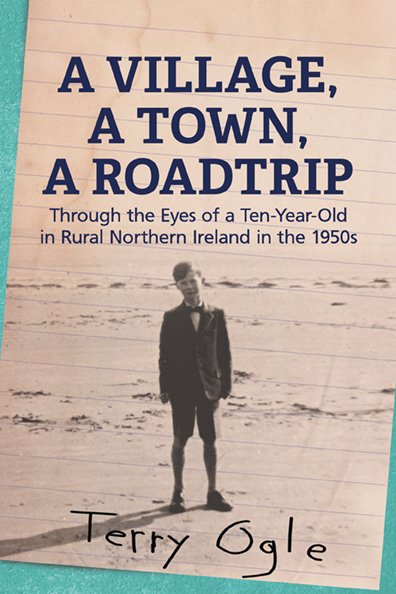
A Village, A Town, A Road trip.
“It’s a memoir. No thanks. I don’t like life history, especially if it’s not even a famous person. I’m not interested. Pass.”
“Wait a minute. Let me explain:”
Firstly, it’s not about an entire life, it’s about a year in a life, 1955 mostly. The things special about the book are: it all happened a long time ago, it was in Northern Ireland and it is narrated by a naive ten-year-old country boy. The book covers the period some thirty years after partition and shows the ingrained prejudice that led to the euphemistically called “Troubles” which began in the sixties and lasted for thirty years. More than 3,500 people were killed in shootings and bombings during the “Troubles” many of them civilians.
True, it is nostalgia packed, and informative about life in the 1950s. Most people didn’t have TV, cars were mostly British (at least in Northern Ireland), food was basic meat and veg but folks were well satisfied with it. Alcohol and smoking were common place and encouraged (indulged by old and young). Prejudice was rife. The war (1939-45) and its lingering effects (bomb sites, rationing, the American invasion of Ireland then Britain then Europe) was well remembered. Rationing of food had only just stopped in 1954.
In spite of the brutal context It is a funny, and amusing read.
“Like a hyper realistic painting the detail, the colour, the convincing feel for Terry’s childhood is vivid and the story gives a faithful and very human view of a brittle, old-fashioned and seemingly well-mannered society that in a decade would shatter and fall into a gruesomely uncivil civil war. The Northern Ireland ‘Troubles’ (such an understated word for the murder of more than 3,000 people) made global headlines for thirty years, and Terry Ogle sets the scene for it in microcosm. This is a self-portrait of a 10-year old, not history, a memoir enriched with creativity not a factual autobiography (no one could remember such vibrant detail after seven decades). Yet for all that, and perhaps because if it, anyone who knows Northern Ireland, or wants to understand it, will be enriched by this account.”
~ Nick Ross (BBC)